Pennsylvania Guild of Craftsmen Celebrates 80 Years of Mastery with Fine Art Photographer
James Evangelista

We continue our Celebration of 80 Years of Fine Craftsmanship's Master Artisan series with Senior Master Artisan James Evangelista.  James has had a long career in professional photography, shooting subjects that ranged from backstage images of Tina Turner to spiritually significant landscapes of the American Southwest. We are sure you will enjoy getting to know James a little better.
 
PGC: When did you know you wanted to be an artist/artisan?
James: Throughout my life I always had a camera in my hand and taking pictures was my favorite way to communicate. All through the military and all through collage, the one constant in my life was photography. But it wasn’t until my career as a commercial photographer was starting to become too routine that I knew I wanted to produce fine art photography.

PGC: Why did you choose your medium – or how did it choose you?
James: There’s some magic that happens when you find the right form to tell your story in just the right way and for me, that was photography. As far as I am concerned, I photograph because I really have no other choice. This is what I do. This is what I am.

PGC: What kind of music do you like? Do you listen to it in your studio or do you like to work in quiet? 
James: I have a wide repertoire of music that I listen to, pretty much everything from Pavarotti to Jimi Hendrix.  Usually if I’m in the studio or working in post production I’ll dial in some music but when I’m on location I never do.

PGC: If you were to choose a different way to express your creativity, how might you do it - poetry, cooking, tap dancing, other medium?
James:

I’ve been pursuing poetry and reflective prose alongside my photography, exploring many of the same things that draw me to the camera: time, memory, aging, the natural world, and the quiet moments that often go unnoticed. Photography allows me to work with light and image; writing allows me to explore what lies beneath them. I find that each practice informs the other, and both continue to teach me how to see.

PGC: What part of your process gives you the most trouble?
James: The technicalities of the digital process. When I was shooting film, my enlarger never crashed but my computer does, as does my printer.

PGC: What part brings you the most joy? 
James: It doesn't get any better than waking up early for sunrise and being rewarded with beautiful light.

PGC: Who inspires you, gives you energy - someone you know, a mentor, an idol?
James: Current influences include most all of my colleagues, friends, and fellow photographers who, collectively, provide ongoing support, encouragement, and inspiration along with Irving Penn, Ernst Haas and, of course, Ansel Adams.
My Interview with Shoutout Magazine

We had the good fortune of connecting with James Evangelista and we’ve shared our conversation below.

Hi James, can you walk us through the thought-process of starting your business?
I was already working as a commercial photographer for a few studios and at every shoot I would prioritize the importance of preproduction and proper planning before starting a photo shoot. Good photographers have to be excellent businessmen and they don’t just show up on set and figure it out as they go, because doing so would limit their creativity and force the client to settle for images that are good enough instead of images that are exceptional! Once I was able to make this happen with a certain degree of certainty and the studios' clients started to request me for their shoot I decided it was time.

Let’s talk shop, Tell us more about your career, what can you share with our community?

Photography has been the constant in my life for as long as I can remember. Through my years in the military and throughout college, I always had a camera in my hand. It was my favorite way of communicating with the world, long before I understood that it would become my career.

I spent many years as a commercial photographer, working with clients and art directors to bring their ideas to life. Eventually, the work began to feel routine, and I found myself drawn toward something more personal: fine-art photography. I wanted to make images that were not simply about what a place looked like, but about what it made me feel.

The transition taught me that, whether collaborating with an art director or connecting with a gallery owner or a person who takes one of my prints home, the heart of the work is much the same. It is about finding the right way to tell a story and making a connection that goes beyond the image itself.

Today, my work takes me far from the studio, from the first light of morning in Bryce Canyon to the late-afternoon glow of a small fishing village in Maine. I photograph the American landscape, drawn to the silence of the desert, the play of light and shadow, and the enduring forces of wind and water.

After all these years, I am still searching for the same thing: not simply a beautiful scene, but the feeling beneath it. And above all, a sense of mystery.

Let’s say your best friend was visiting the area and you wanted to show them the best time ever. Where would you take them? Give us a little itinerary – say it was a week long trip, where would you eat, drink, visit, hang out, etc.
I’m from South Philly and I never forgot where I came from. Philadelphia has evidence of a richness and grace that separates it from other cities and rewards even the casual viewer with a blending of history and architecture. And, of course, Philadelphia is a major sports town. I frequent Ralphs Italian Restaurant, its been in business 125 years and is the oldest family-owned and operated Italian restaurant in the country. I also like South Restaurant & Jazz Club in the Spring Garden neighborhood on Avenue of the Arts. If my friend is into history I would take him to Independence Hall, a UNESCO World Heritage site and where the Declaration of Independence was signed. Philadelphia is one of just a handful of U.S. cities that’s lucky enough to have its professional basketball, football, hockey and baseball teams all play within city limits. In fact, those four Philadelphia teams all play in the same complex, known as The South Philadelphia Sports Complex and if my friend was into sports I could think of no better place to go.

The Shoutout series is all about recognizing that our success and where we are in life is at least somewhat thanks to the efforts, support, mentorship, love and encouragement of others. So is there someone that you want to dedicate your shoutout to?
My current influences include most all of my colleagues, friends, and fellow photographers who, collectively, provide ongoing support, encouragement, and inspiration along with Irving Penn, Ernst Haas and, of course, Ansel Adams.


In the Loupe

01/06/2026

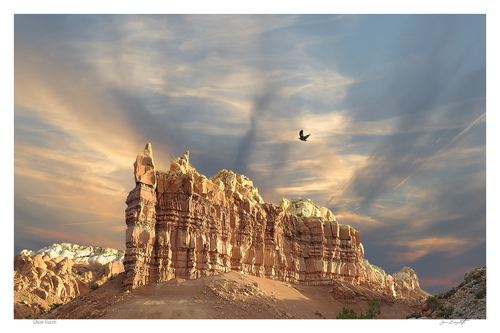
The sandstone cliffs of Ghost Ranch rise like ancient, sun-baked monoliths, their massive faces catching the first pale lavender of dawn. Before the heat of the day settles over the valley, I walk among the broken talus at the foot of the ridges, where the air is still cool enough to hold the scent of damp piñon and bruised sage. In this early light, the world is hushed, waiting for the sun to strike the heights. I sat for hours watching, I found my eyes drifting from the canvas of the cliffs to the sky above them. Hawks and ravens rose on the invisible thermals, and occasionally a golden eagle appeared, high, solitary, moving with a fluid grace that made effort look like a forgotten language. They did not seem in a hurry to arrive anywhere. Watching them navigate the vast, empty air, these birds, in their quiet, instinctual mastery of the wind, had taught me more about this landscape than words ever could.
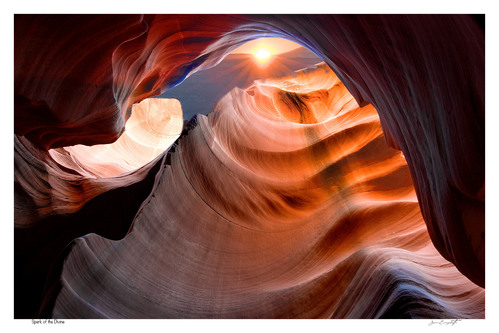
In the subterranean stillness, a single human breath, briefly joining a place whose only enduring architects have been water, wind, and time. At the mouth of the sandstone canyon, the entrance is a sudden vertical fracture in the desert floor. Before we step inside, Vera pauses at the threshold. The old people, she tells us, never entered these shadows casually. They stopped here first to quiet the mind, preparing themselves to enter a place that required humility, so they might return to the sunlight in balance with the world. The Navajo call this place Tsé bighánílíní—the place where water runs through rocks. We leave the pale sun behind and descend into the earth. The walls rise more than a hundred feet above the dry wash, their sandstone sculpted by vanished torrents into flowing ribbons of amber, ochre, and deep violet. Every curve bears the memory of water. Every narrowing reminds us that absence can be a sculptor as patient as time.

04/15/2025

For m every image begins in the landscape, not on a computer. When I photograph I am working deliberately with light, composition, and exposure to create the strongest possible image in the moment. Years of studying the Zone System continue to shape the way I see, guiding how I place tones and preserve detail. Processing is intentionally restrained. Lightroom is used to refine the photograph, not reinvent it, through careful adjustments to tone, contrast, and color. I don't composite images, replace skies, or rely on heavy manipulation. My goal is to reveal what was already there. Every print is produced in my studio using a color-calibrated workflow, giving me complete control over the final image from capture to print. Photography, for me, has always been about seeing the light, not creating it.
I am honored and amazed to share that out of almost 2000 submissions, my photograph, "Divine Ascent", has been awarded a Jury Top 3 at the Art of the State Awards. My photograph is on exhibit at The State Museum of Pennsylvania thru January.
We set out on Tre Cime di Lavaredo
Annual "Art of the State" A feast for the eyes and the emotions; winners announced. 
No Masks Required!

Interviews

Pennsylvania Guild of Craftsmen Celebrates 80 Years of Mastery with Fine Art Photographer
James Evangelista

We continue our Celebration of 80 Years of Fine Craftsmanship's Master Artisan series with Senior Master Artisan James Evangelista.  James has had a long career in professional photography, shooting subjects that ranged from backstage images of Tina Turner to spiritually significant landscapes of the American Southwest. We are sure you will enjoy getting to know James a little better.
 
PGC: When did you know you wanted to be an artist/artisan?
James: Throughout my life I always had a camera in my hand and taking pictures was my favorite way to communicate. All through the military and all through collage, the one constant in my life was photography. But it wasn’t until my career as a commercial photographer was starting to become too routine that I knew I wanted to produce fine art photography.

PGC: Why did you choose your medium – or how did it choose you?
James: There’s some magic that happens when you find the right form to tell your story in just the right way and for me, that was photography. As far as I am concerned, I photograph because I really have no other choice. This is what I do. This is what I am.

PGC: What kind of music do you like? Do you listen to it in your studio or do you like to work in quiet? 
James: I have a wide repertoire of music that I listen to, pretty much everything from Pavarotti to Jimi Hendrix.  Usually if I’m in the studio or working in post production I’ll dial in some music but when I’m on location I never do.

PGC: If you were to choose a different way to express your creativity, how might you do it - poetry, cooking, tap dancing, other medium?
James:

I’ve been pursuing poetry and reflective prose alongside my photography, exploring many of the same things that draw me to the camera: time, memory, aging, the natural world, and the quiet moments that often go unnoticed. Photography allows me to work with light and image; writing allows me to explore what lies beneath them. I find that each practice informs the other, and both continue to teach me how to see.

PGC: What part of your process gives you the most trouble?
James: The technicalities of the digital process. When I was shooting film, my enlarger never crashed but my computer does, as does my printer.

PGC: What part brings you the most joy? 
James: It doesn't get any better than waking up early for sunrise and being rewarded with beautiful light.

PGC: Who inspires you, gives you energy - someone you know, a mentor, an idol?
James: Current influences include most all of my colleagues, friends, and fellow photographers who, collectively, provide ongoing support, encouragement, and inspiration along with Irving Penn, Ernst Haas and, of course, Ansel Adams.


My Interview with Shoutout Magazine

We had the good fortune of connecting with James Evangelista and we’ve shared our conversation below.

Hi James, can you walk us through the thought-process of starting your business?
I was already working as a commercial photographer for a few studios and at every shoot I would prioritize the importance of preproduction and proper planning before starting a photo shoot. Good photographers have to be excellent businessmen and they don’t just show up on set and figure it out as they go, because doing so would limit their creativity and force the client to settle for images that are good enough instead of images that are exceptional! Once I was able to make this happen with a certain degree of certainty and the studios' clients started to request me for their shoot I decided it was time.

Let’s talk shop, Tell us more about your career, what can you share with our community?

Photography has been the constant in my life for as long as I can remember. Through my years in the military and throughout college, I always had a camera in my hand. It was my favorite way of communicating with the world, long before I understood that it would become my career.

I spent many years as a commercial photographer, working with clients and art directors to bring their ideas to life. Eventually, the work began to feel routine, and I found myself drawn toward something more personal: fine-art photography. I wanted to make images that were not simply about what a place looked like, but about what it made me feel.

The transition taught me that, whether collaborating with an art director or connecting with a gallery owner or a person who takes one of my prints home, the heart of the work is much the same. It is about finding the right way to tell a story and making a connection that goes beyond the image itself.

Today, my work takes me far from the studio, from the first light of morning in Bryce Canyon to the late-afternoon glow of a small fishing village in Maine. I photograph the American landscape, drawn to the silence of the desert, the play of light and shadow, and the enduring forces of wind and water.

After all these years, I am still searching for the same thing: not simply a beautiful scene, but the feeling beneath it. And above all, a sense of mystery.

Let’s say your best friend was visiting the area and you wanted to show them the best time ever. Where would you take them? Give us a little itinerary – say it was a week long trip, where would you eat, drink, visit, hang out, etc.
I’m from South Philly and I never forgot where I came from. Philadelphia has evidence of a richness and grace that separates it from other cities and rewards even the casual viewer with a blending of history and architecture. And, of course, Philadelphia is a major sports town. I frequent Ralphs Italian Restaurant, its been in business 125 years and is the oldest family-owned and operated Italian restaurant in the country. I also like South Restaurant & Jazz Club in the Spring Garden neighborhood on Avenue of the Arts. If my friend is into history I would take him to Independence Hall, a UNESCO World Heritage site and where the Declaration of Independence was signed. Philadelphia is one of just a handful of U.S. cities that’s lucky enough to have its professional basketball, football, hockey and baseball teams all play within city limits. In fact, those four Philadelphia teams all play in the same complex, known as The South Philadelphia Sports Complex and if my friend was into sports I could think of no better place to go.

The Shoutout series is all about recognizing that our success and where we are in life is at least somewhat thanks to the efforts, support, mentorship, love and encouragement of others. So is there someone that you want to dedicate your shoutout to?
My current influences include most all of my colleagues, friends, and fellow photographers who, collectively, provide ongoing support, encouragement, and inspiration along with Irving Penn, Ernst Haas and, of course, Ansel Adams.